Frenhofer, c’est moi: Jacque Rivette’s La Belle Noiseuse
An earlier version of this piece first appeared in Penicillin#28 (June 3, 2022)

“I am Frenhofer,” Paul Cezanne said upon reflection of Honoré de Balzac’s story Le Chef-d’œuvre inconnu (The Unknown Masterpiece). The same story filled Pablo Picasso with such awe that he moved to the same area of Paris where the story took place (rue des Grands-Augustins—where he painted Guernica). More than a century after Balzac published his story came the 1991 modern film adaptation La Belle Noiseuse (The Beautiful Troublemaker) from French New Wave director Jacques Rivette.
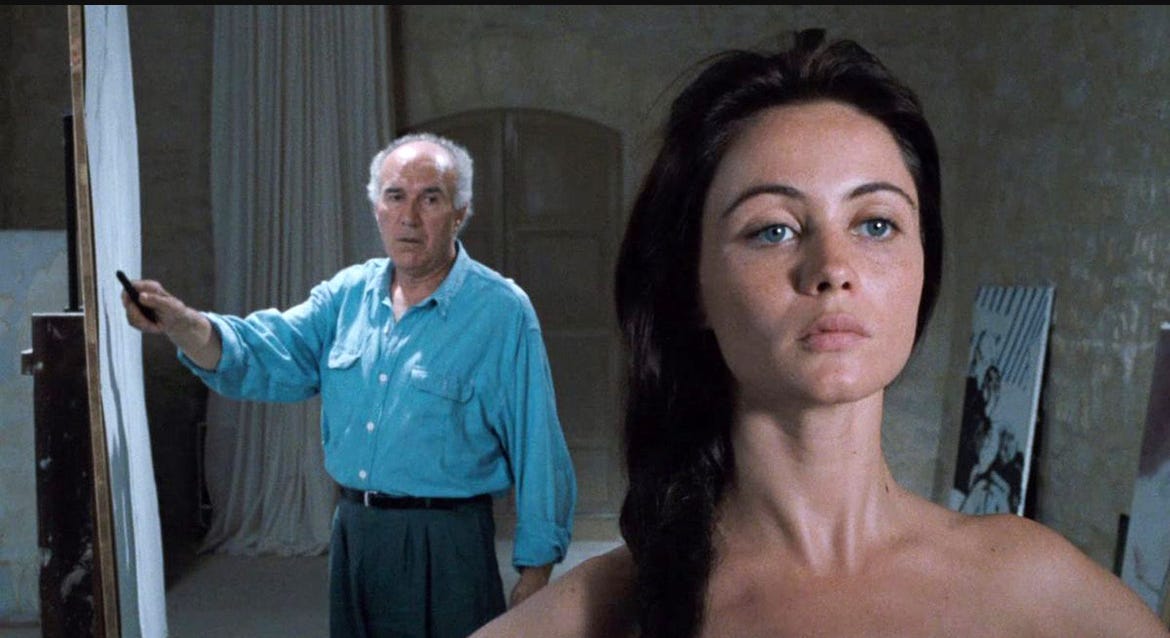
The film clocks in with a runtime over four hours. On the surface, that seems incomprehensible given the film’s simple plot: Nicolas (David Bursztein), a young artist, visits the deteriorated chateau of the older and inactive artist Frenhofer (Michel Piccoli) and his wife Liz (Jane Birkin). Accompanying Nicolas are his girlfriend Marianne (Emmanuelle Béart) and the art dealer Porbus (Gilles Arbona). While in discussion with Frenhofer and Porbus, Nicolas offers Marianne as a model to the aging artist so he can finish “The Beautiful Troublemaker”, his long-awaited masterpiece. Marianne isn’t happy when she learns this but agrees to model for Frenhofer—practically in spite of Nicolas.
Like a good number of non-Hollywood films, it’s not so much the plot that matters but more the subtle behavioral and visual nuances that occur as events casually unfold. And really, the runtime helps here, because the film takes on almost a lifelike quality where changes creep up but don’t really announce themselves.
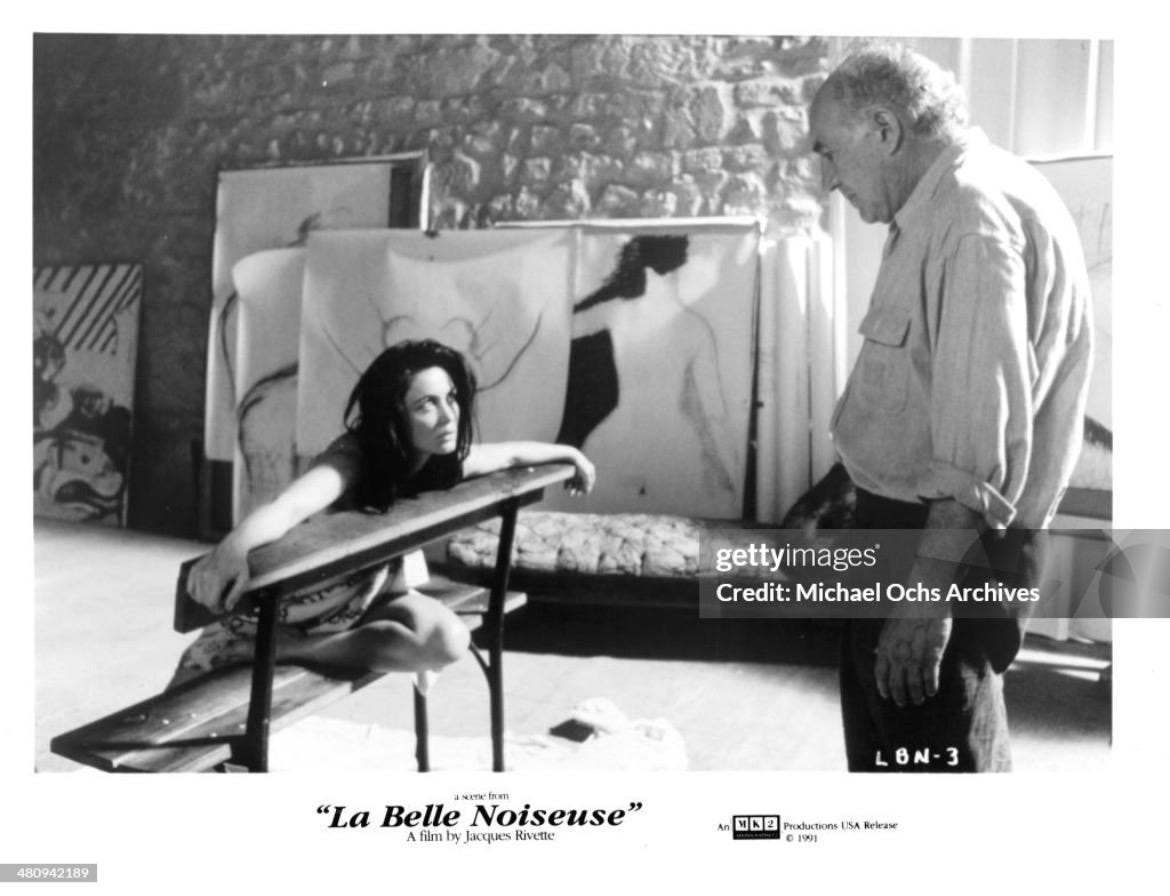
A key example of this is the relationship between Marianne and Frenhofer—which a majority of the film focuses on. Marianne sneaks out of her hotel room while Nicolas sleeps, surprising Frenhofer with her behavior (he admits he did not think she would even show up to model). During their modeling sessions, a subtle shift in the balance of power occurs: Marianne, though tentative, is fully compliant to Frenhofer’s direction. He quickly orders her around, then starts freely maneuvering her body with his hands, almost sculpting her like a flesh doll (this brings to mind Tony Sacco’s documentary Nude, about French photographer David Bellemere—who unusually manhandles his models—a practice which eventually got Bellemere in trouble). Gradually, Marianne starts posing of her own volition—to the point Frenhofer is begging her to keep a pose, almost a servant to her whims…the muse dominating the artist…
In a way, Emmanuelle Béart begins to dominate us as viewers—not so much her body but her gaze, her piercing blue eyes, almost a provocation, confronting us. Even the film itself confirms this, as Frenhofer’s wife urges Marianne not to let the artist paint her eyes, as it will reveal some terrifying truth. And while we never see that truth, we only get glimpses of it through Béart’s performance: She allows herself to be dominated by Frenhofer (and us, the audience, by extension), but at the same time her gaze asks if you have the nerve to dominate, to act, to be more than just a voyeur. And if you are more than a voyeur, what will the result be? Can you handle the consequences? By film conclusion, the artist really can’t (he hides the final painting—which we never see—after it repulses both Marianne and Liz).
If it wasn’t for the charisma and beauty of Béart, I doubt any of these questions or themes would come to mind. I remember first seeing her in Claude Berri’s Manon of the Springs (1986) as a young teen. I didn’t know her name but she left an impression—to the point I recognized her a few years later when she appeared in the first Mission: Impossible film. Despite the latter film being family-friendly blockbuster entertainment, Béart’s presence (the way star Tom Cruise manhandled her and the way director Brian De Palma photographed her) couldn’t help but give the film a sexual energy the other franchise entries lack.
BUT!
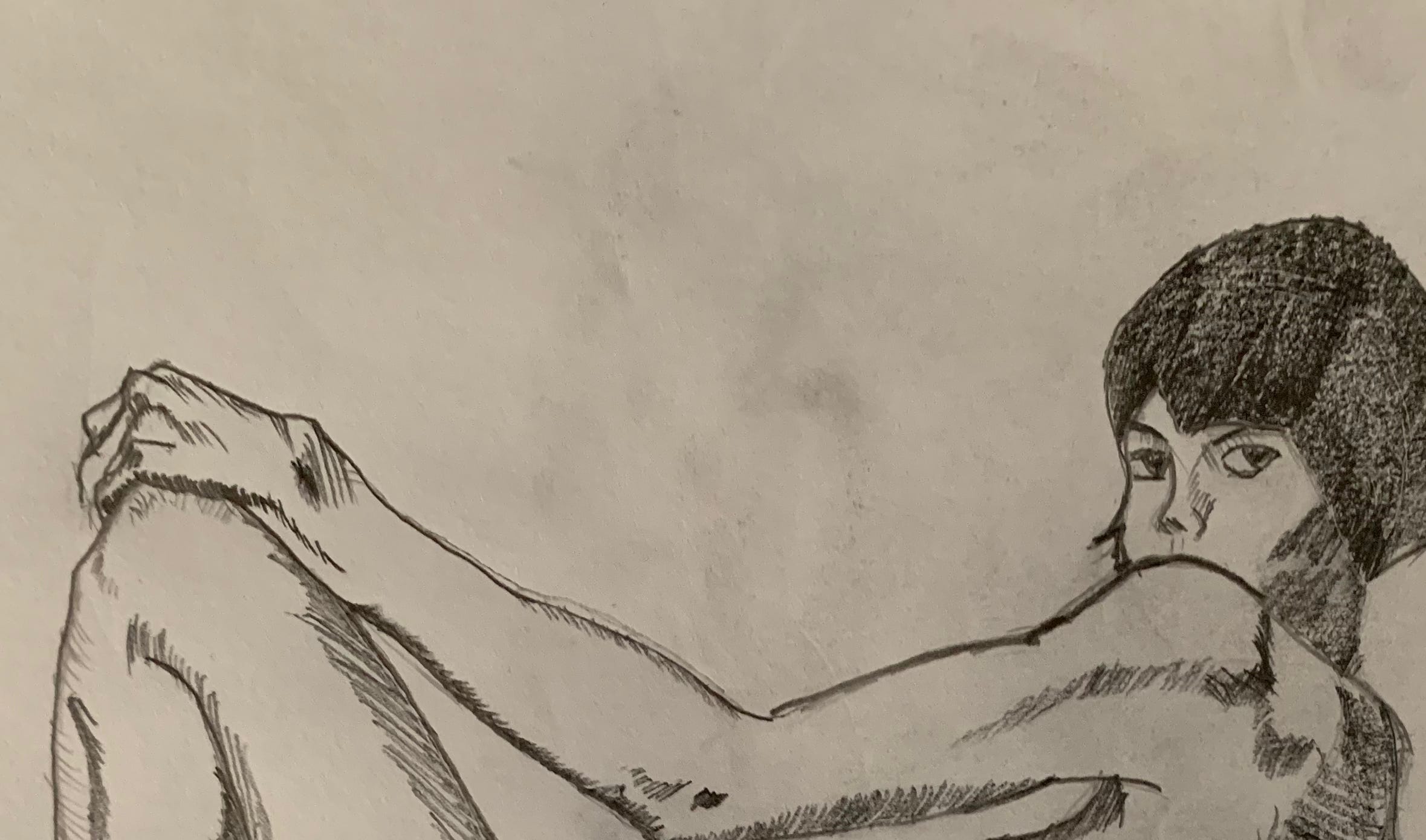
There’s a passiveness in Béart’s Mission: Impossible performance. In La Belle Noiseuse there’s a defiance. Her body, her ample breasts, her supple curves and healthy amount of pubic hair, are presented at first as a sexual object. She disrobes before the camera, presenting her body to the artist Frenhofer and by proxy, us the audience. However, the sexual object quickly transforms in to an art object, a subject to be contended with, analyzed and captured, with the sexual energy becoming an artistic energy but both artist and object never lose their sexual charge, it just…transforms, almost transcends.
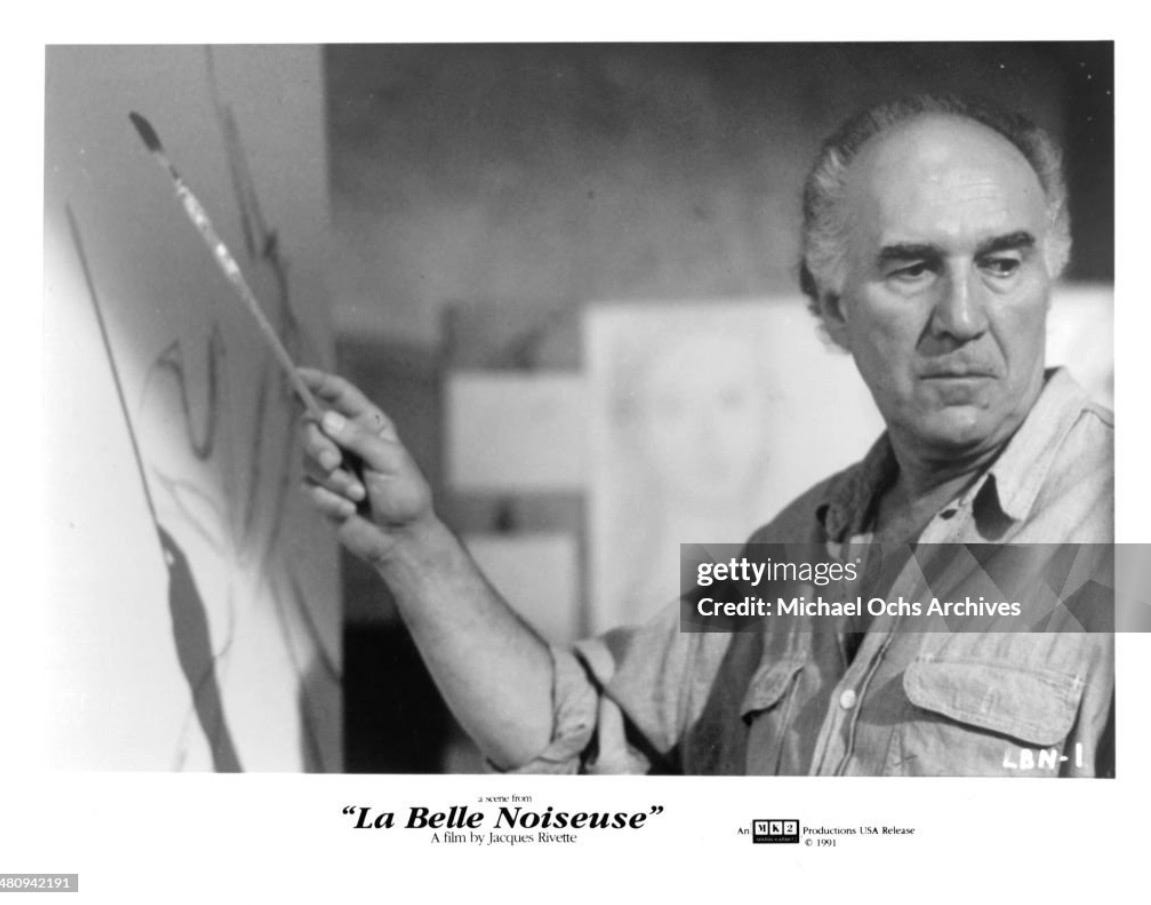
That’s probably a good reason why the film never feels boring, despite its long duration. We watch with anticipation as Frenhofer tries to capture the spiritual reality of Marianne, his charcoals, pens and brushes frantically moving over their respective canvases. It probably helped that it’s not the hand of actor Michel Piccoli doing the artistic work but rather famed French artist Bernard Dufour. But Piccoli’s performance is important. His gaze—his entire demeanor—feels lived-in. He seems like an artist.
Jane Birkin, who plays Frenhofer’s wife Liz, also performs her role with an unassuming naturalism. In a way, as a supportive wife of a struggling artist—yet also as a discarded model (it’s noted how Frenhofer tried and failed to use her as the original model for his painting)—Birkin exudes more sexuality than Béart, because she isn’t naked for us, but covered, moving through the environs, not confronting at all, but emanating an almost feminine passivity. Her imperfections (bad teeth, plain fashion, thin figure, etc.) present a grace as she walks through the hallways of her dilapidated home, or puts a sympathetic hand on the concerned Nicolas’ shoulder, trying to comfort him as his girlfriend poses nude for another man. We never see her naked, but the teases (her discussing modeling or not wearing a bra, etc.) and demure behavior put her in stark contrast to the naked and direct Marianne.
What one would expect to happen in a conventional Hollywood film (artist and model having an affair or jilted artist wife and model boyfriend also having an affair) does not happen here. Unlike other films about artists, there’s no mystery (Michelangelo Antonioni’s Blowup), no grand existential or philosophical themes (Andrei Tarkovsky’s Andrei Rublev), and no satire (Jean-Luc Godard’s Contempt or Terry Zwigoff’s Art School Confidential). In a way, it’s similar to Eric Rohmer’s La Collectionneuse, in that they both feature artists as characters, both take place in countryside mansions, and both are about relationships, but the similarities are superficial. Rohmer’s films primarily concern the dynamics of romantic relationships, while La Belle Noiseuse is about art, the artistic process and how it affects relationships.
Film director Robert Bresson (an influence on the French New Wave), a former painter inspired by Cezanne, referred to his actors as “models”. His female models refused to interact with one another over the years because the director made them all feel so special and unique, that to meet another model would be like meeting another lover, arousing the same sort of jealousy.
At film conclusion, Marianne and Nicolas go their separate ways, not because of jealousy but because artistic process exposed some wound that always haunted their relationship (I’m leaving out the late arrival of Nicolas’ sister to the film but it’s of little consequence here). More importantly, despite a relationship of cooperation between Marianne and Frenhofer, his final painting, as mentioned above, disturbs her. Frenhofer publicly unveils a different painting that does not feature Marianne’s face while permanently hiding the original behind a brick wall.
Art and the artistic process has personal consequences for those immediately surrounding the artist—especially when models are involved. Someone being drawn or painted (or photographed, in the case of film), is someone being examined. It can be intensely flattering, but it can also be intensely revealing and uncomfortable (I remember one model immediately exclaiming she needed to lose weight after seeing the drawing I did of her). At the end ofLa Belle Noiseuse, after the artistic process, something has changed for all involved. Life has not imitated art, but rather, life has been revealed and affected by art. Any artist watching the film may recognize this and feel the sudden weight as the credits roll. Frenhofer, c’est moi.